Accidental science
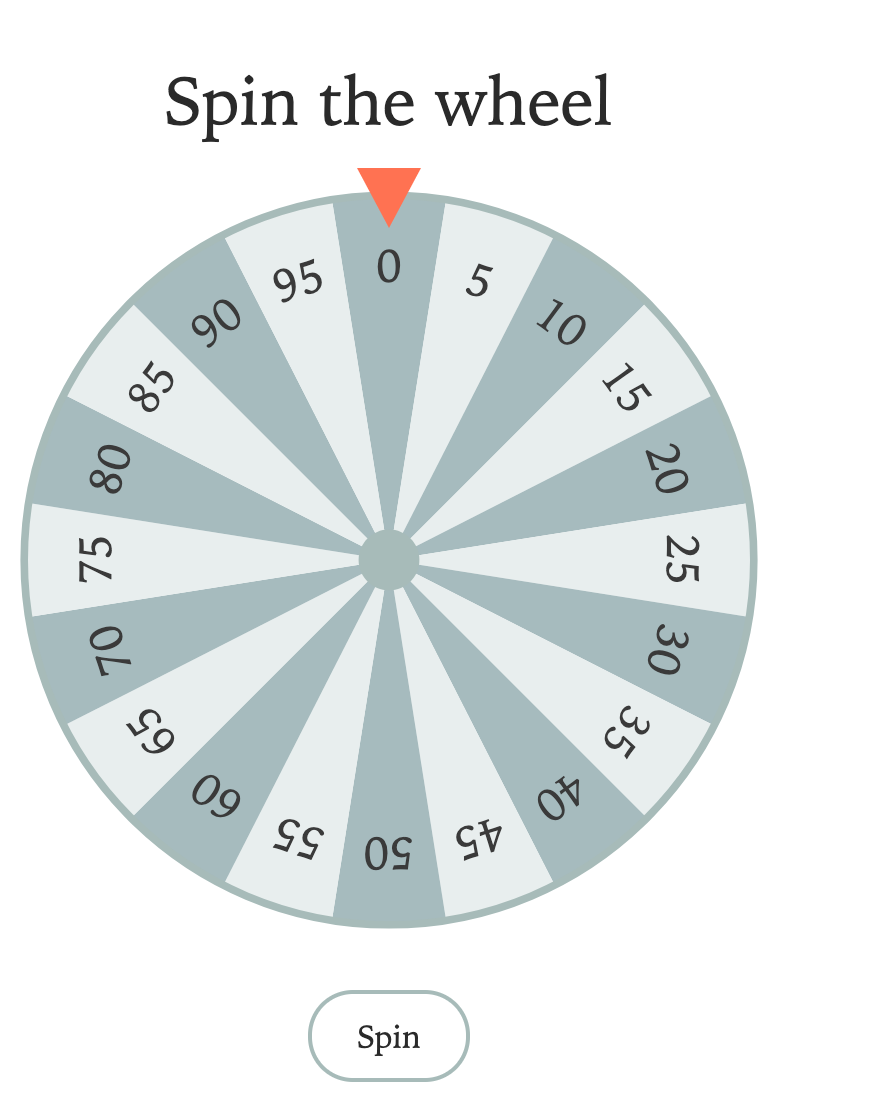
In the current version of Raydiate I ran a small experiment. Tversky & Kahneman (1974) did a classic study on anchoring. The idea of the study is that when people make an estimate, they unconsciously start from a number they have just seen, even when that number has nothing to do with the question. They do adjust their answer away from that ‘anchor’, but not enough. In the original study participants spun a wheel of fortune that stopped at either 10 or 65. Those who saw 10 estimated the share of African countries in the UN at 25% (median), those who saw 65 at 45%.
For my lecture I built a web page on which students first spin a wheel of fortune. The wheel secretly only lands on 10 or 65. After that they are asked what percentage of UN member states are African countries.
| Wheel | My group | n | Original study |
|---|---|---|---|
| 10 | 23% | 4 | 25% |
| 65 | 45% | 6 | 45% |
The correct answer today: 28% (54 of 193 UN members).
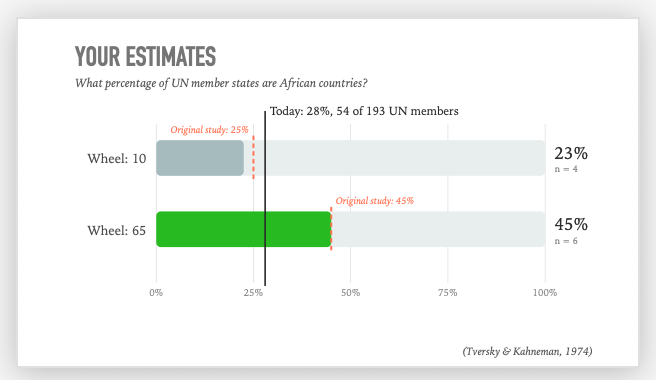
The low anchor pulled estimates down, the high anchor pulled them up — almost exactly the numbers from the original study, with only ten participants.
Raw answers
The percentages above are medians. These are all the individual answers:
| Wheel | Answers (sorted) | Median | Mean |
|---|---|---|---|
| 10 | 15, 20, 25, 80 | 22.5 | 35 |
| 65 | 25, 30, 40, 50, 55, 70 | 45 | 45 |
Is this significant? Not at all. Ten students, four in one group and six in the other, is far too small to prove anything. But the effect goes in the same direction as in the original study, and the medians are almost identical. Nice way to demonstrate the anchoring effect within a lecture..
Source
Tversky, A., & Kahneman, D. (1974). Judgment under Uncertainty: Heuristics and Biases. Science, 185(4157), 1124–1131. doi:10.1126/science.185.4157.1124