Hamaki and Shortcuts
Hamaki supports macOS Shortcuts. You can query your schedule, retrieve visitor information, and create spots from any Shortcut, Focus automation, or Siri command.
Here is what is currently available:
Appointments for Day
Returns all appointments for a given date. Each result includes the visitor name, email, time, and calendar.
Useful for building a daily briefing shortcut, logging your day, or triggering follow-up automations after appointments.
Get Appointment Details
Takes a Hamaki event ID and returns the full details for that spot: visitor name, email, start date, and any comment the visitor left at booking.
This action is particularly useful in combination with the note taking integration. When you link a Shortcut to a calendar’s note taking setting, Hamaki passes the event ID to your Shortcut automatically. Your Shortcut can then call “Get Appointment Details” to get the visitor’s name and open or create the right note.
Get Visitor Pulse
Returns the booking pattern for one or more visitors: how many times they have visited, when they last came in, and roughly how often they come back.
Create Spots for Calendar
Creates one or more available booking slots in a calendar for a given date and time range.
Next Appointment
Returns the next upcoming booked spot across all your calendars, with visitor name, time, and calendar.
Today’s Summary
A quick overview of today: how many spots are booked, how many are still free, and who is coming in next.
Example: Daily note in Obsidian
One thing I use myself: a Shortcut that builds a Markdown table of today’s appointments and appends it to my Daily Note in Obsidian.
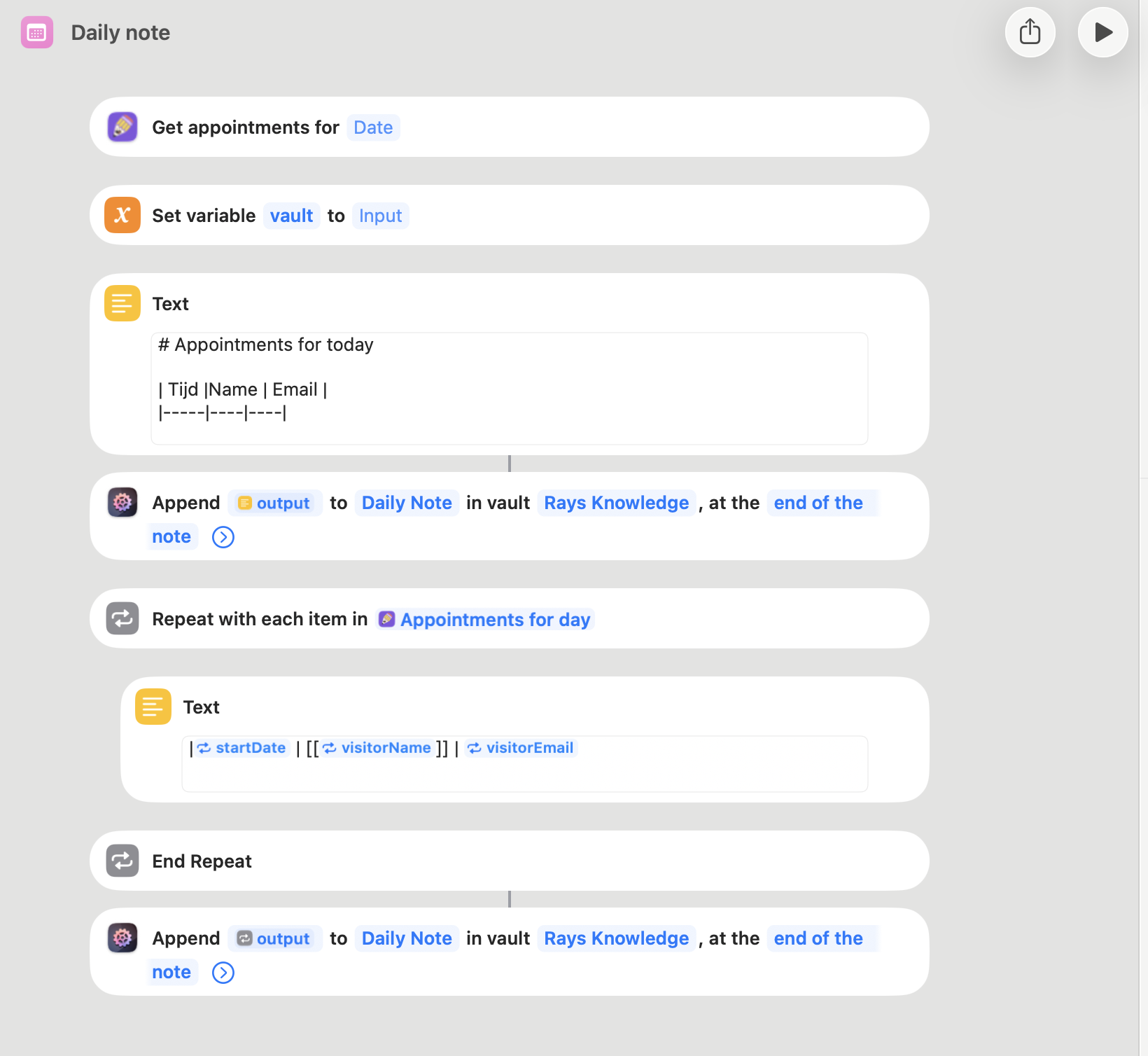
The Shortcut gets today’s appointments from Hamaki, creates a table header, and loops through each appointment to add a row with the start time, visitor name, and email. Two “Append to Daily Note” steps in Obsidian take care of writing it out.
Every morning I run it to prepare for the day.
Note taking with Shortcuts
If you use Apple Notes or any app that does not have a direct URL scheme, you can connect it to Hamaki via a Shortcut.
In calendar settings, under Note Taking, select Shortcut or Apple Notes and enter the name of a Shortcut you have built. When you open a visitor’s note from Hamaki, it calls your Shortcut with the appointment’s event ID. Your Shortcut then calls “Get Appointment Details” to get the visitor’s name and opens or creates the note.
You build the Shortcut once, and it works for every visitor in that calendar.
Using Hamaki actions in Siri
All Hamaki actions are available in Siri. And they work pretty well, when Siri does its work the way it should. Then you can ask things like:
- “What is my next appointment?”
- “Create a spot in my coaching calendar tomorrow at 2pm”
 Hamaki
Hamaki is a scheduling app for Mac. Scheduling appointments is a time sink. Hamaki fixes that: share a booking page, let people pick a slot, done. No back-and-forth emails, no sharing your calendar with a cloud service.
Hamaki is a real Mac app. It lives in your menu bar, works with Calendar.app, supports Shortcuts and MCP, and keeps your data on your machine. Your calendar stays yours.
Shortcuts integration is available from version 2026.1. Find all Hamaki actions by searching for “Hamaki” in Shortcuts.app.